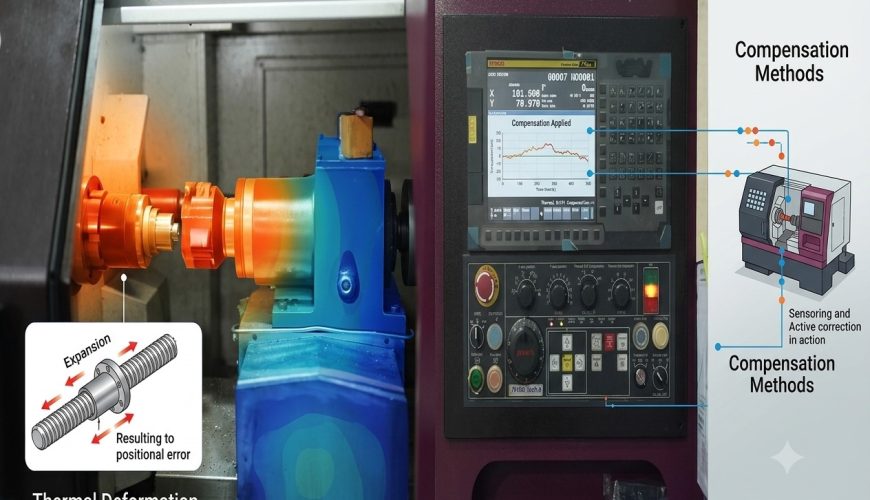
Temperature is among the most overlooked parameters affecting precision manufacturing. When CNC lathes run for extended periods, significant quantities of heat are generated in the spindle, cutting tool, part being cut, and machine structure. All of which will affect the material dimensional properties by causing them to expand. Even slight temperature deviations can result in out-of-tolerance conditions for machined parts.
In industries such as aerospace, oil and gas, and semiconductor manufacturing, where high precision is required, such deviations are not acceptable. Therefore, the need for thermal stability has become a key factor in how top-tier CNC machining companies perform high-precision turning operations.
Why Heat Is a Problem in CNC Turning
Machine shops that use CNC turning will be creating heat in three different ways:
· Friction between the cutting tool and workpiece
· Friction created by the spindle motor or spindle bearings
· Temperature from the working environment – ambient conditions
Metals tend to expand when exposed to heat. For example, aluminum expands approximately twice as much as steel when heated. A 6-inch aluminum part that is heated by 10˚ will change in size by .001″ or greater. This type of size differential, when dealing with tolerances of +/- 0.0005″, would be considered scrap.
The machine tooling (CNC lathe) will also absorb heat generated during production, and the spindle bearings, ball screws, linear guides, and all will change size due to it. CNC machining manufacturers that do not allow for these temperature changes will experience some form of dimensional drift from the first part produced until the last part produced.
Common Sources of Thermal Error in CNC Machines
· Spindle Heating
The spindle becomes the highest heat-generating source when it accelerates and reaches high rpm. The heat generated by the bearings will be transmitted from the bearings to the housing and then to the structural components of the machine, causing the spindle to grow in length along its axis. This process of heating causes the position of the tool to change in relation to the part being machined.
· Cutting Zone Heat
The cutting zone generates localized heat at an intense and concentrated level, and if no effective method of delivering coolant to the cutting zone is used, the heat generated from this cutting process will be transferred to the workpiece, causing the workpiece to expand locally and affect surface finish and dimensional accuracy.
· Ambient Temperature Variation
The temperature in a machine shop will vary throughout the day. For example, a machine operating in a shop with a temperature of 65 degrees, producing in the morning, and then again at 65 degrees, producing at 7 degrees in the afternoon will yield drastically different results unless there is a thermal compensation system in place. First-class CNC machining manufacturer control or monitor the ambient temperature as part of their quality assurance processes.
· Structural Components
Ball screws, columns, and beds are components of the machine that absorb heat from electric motors and friction. As they heat up and expand, their lengths change and will therefore cause the machine to be positionally inaccurate.
Thermal Compensation Methods Used by Leading CNC Machining Manufacturers
Machine Operations to Warm-Up
Before producing any kind of components, well-trained operators operate the equipment through an operating speed warm-up cycle. It brings the spindle and framework near to thermal equilibrium before starting to produce any type of components during that time because of thermal expansion or contraction of their parts.
Workholding with Temperature Compensation
Collect and fixtures constructed from reduced growth alloys reduce the thermal impact of workholding on the placement of a component. If any type of workholding material alters size due, for instance, to thermal effects on its placement/size it will impact placement of the part relative to the reducing device.
Real-Time Temperature Compensation
Contemporary CNC devices come equipped with temperature compensation software that reads the temperature sensors atmospherically placed throughout the CNC machine. From the temperature measurements observed, the software program establishes the thermal growth of the CNC machine based on those temperature measurements and, applies position modifications automatically; thus, the final machining accuracy is maintained. Real-time temperature compensation software is one of the most beneficial tools offered to CNC machine manufacturers within the industry that perform machining at high precision.
Coolant Strategy
Coolants are not only there to offer lubrication at the cutting site; when applied in the correct manner can also control heat at the source, thereby reducing the amount of heat energy that travels into the workpiece and machine. Particularly with internal turning operations and deep holes, through-spindle coolant delivery is the best way to dispense through boring tools effectively.
Environmental Controls
Facilities that produce with high levels of accuracy control shop floor temperatures to within a very narrow temperature range (generally ±2 degrees Fahrenheit) by utilizing dedicated HVAC systems. Thus eliminating any ambient heat variation from being an error source for thermal impressions. Not all facilities maintain this level of control, but most demanding CNC machine manufacturing operations that supply to aerospace & semiconductor customers do.
How Mentco Manufacturing Addresses Thermal Stability
Mentco Manufacturing’s production processes have been certified by AS9100 and ISO. The CNC machining company uses a structured approach for all aspects of thermal management during the precision CNC turning process. In addition to this structured approach to thermal management, Mentco utilizes in-house CMM inspection systems, dimensional checks during production, and strict process controls to ensure all products are produced with the same accuracy either on an ongoing basis or during production runs.
Mentco provides services to the aerospace, oil & gas, robotic, semiconductor, and instrumentation industries where thermal stability can significantly reduce part performance and ultimately system reliability. Each shipment of products is accompanied by complete documentation of all inspections and records showing the traceability of all associated materials.
Concluding Insights
Thermal stability should be viewed as more than just an optional feature; it is a major factor in producing precision components through CNC machining. It affects the accuracy of dimensions, repeatability of runs, and quality of parts overall.
CNC machining companies that produce the best quality parts will also have the most effective thermal management programs. All the layers- from warm-up programs to coolant strategies; from real-time compensation software to environmental control systems- will assist in reducing the probability of dimension drift and ultimate rejection of a component.
For US manufacturers using CNC machining to make precision-turned components, selecting a CNC machining companies with established thermal management systems and transparency in inspection records may be one of the most effective ways to mitigate production quality and supply chain risk.