Take apart almost any industrial machine and you will probably find a few precision machined parts inside it. Most people never notice them because they are usually hidden deep inside assemblies, engines, automation systems, or equipment housings. Still, these small components often play a major role in how the entire system functions.
A large number of those parts are made through CNC turning.
Over the years, CNC turning has become one of the most commonly used machining methods for manufacturing precision components. Industries rely on it because it allows the same part to be produced repeatedly with reliable accuracy.
For sectors where dimensions need to remain exact, that consistency matters a lot.
Understanding CNC Turned Components
CNC turned components are machined parts produced using a CNC turning machine.
During the process, the material rotates while cutting tools remove sections gradually until the required dimensions are achieved. Since the operation is software controlled, manufacturers can maintain much tighter tolerances compared to conventional manual machining methods.
Most turned parts are round or cylindrical, although modern equipment is capable of handling more detailed shapes as well.
Manufacturers commonly work with materials like:
- Aluminium
- Stainless steel
- Brass
- Copper
- Titanium
- Engineering plastics
The material selection usually depends on how the component will eventually be used.
How the Process Works
The machining process starts with raw material fixed inside the machine spindle.
As the material rotates, cutting tools begin shaping it carefully based on programmed specifications. Depending on the design requirement, several machining operations may happen during production.
These can include:
- Drilling
- Grooving
- Threading
- Boring
- Facing
- Knurling
Because the machine follows programmed instructions throughout the process, production remains highly consistent across batches.
That repeatability is one of the biggest reasons CNC turning is preferred in precision manufacturing environments.
Why Manufacturers Use CNC Turning
There are several practical reasons why manufacturers continue using CNC turning across industries.
One reason is accuracy. CNC turning machines are capable of producing components with tight tolerances that are difficult to maintain consistently through manual machining.
Another advantage is production efficiency. Once the machining program is set correctly, manufacturers can produce larger batches without constantly adjusting the setup.
Surface finish also improves significantly with CNC machining. In many cases, parts require less secondary finishing work afterward.
Automation reduces variation as well. Since most of the operation is computer controlled, there is less dependence on manual adjustments during production.
Industries That Commonly Use CNC Turned Parts
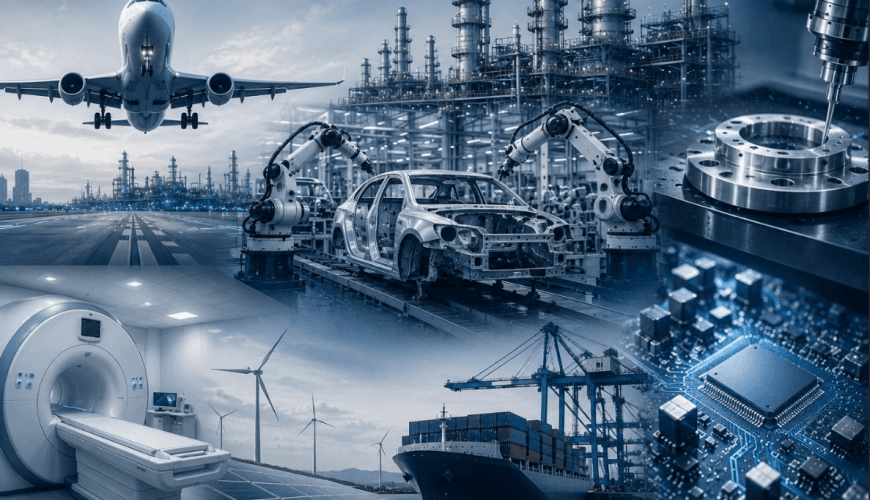
CNC turned components are used across a wide range of industries, especially those that rely heavily on precision engineering.
Aerospace
Aircraft systems contain several machined parts used in engines, hydraulic assemblies, connectors, and structural systems. These components are expected to perform reliably under demanding operating conditions.
Oil and Gas
The oil and gas sector uses turned parts in fittings, valves, connectors, and pressure control systems where durability becomes essential.
Medical Manufacturing
Medical equipment often includes small precision machined parts that require exact dimensions and clean surface finishes.
Semiconductor Industry
Semiconductor manufacturing systems depend on highly accurate components used inside specialised production environments.
Robotics and Automation
Robotics systems rely heavily on precise movement. Even small dimensional inconsistencies can affect performance over time.
Automotive Sector
Vehicles contain CNC turned components in engines, steering systems, braking assemblies, and fuel delivery mechanisms.
Choosing a Reliable Turned Parts Manufacturer
Not every turned parts manufacturer offers the same machining capability or production standards.
Some manufacturers specialise in basic machining work, while others focus on industries that require extremely tight tolerances and complex machining requirements.
Businesses usually evaluate suppliers based on:
- Production capability
- Quality systems
- Inspection methods
- Technical experience
- Delivery reliability
- Material expertise
A manufacturer with strong inspection processes and engineering support generally helps reduce production issues later.
Companies like Mentco work with industries that require high precision machining and consistent production quality.
What Businesses Expect From a CNC Turned Parts Supplier
Expectations from suppliers have changed quite a bit over the years.
Businesses today often look for suppliers that can support both machining and technical coordination during production.
Many companies expect support with:
- Material selection
- Production planning
- Engineering communication
- Inspection reporting
- Consistent machining quality
- Long term manufacturing support
Reliable communication becomes especially important during custom manufacturing projects.
Why CNC Machine Technology Matters
The quality of the machine itself has a direct impact on production results.
Modern CNC turning machines are designed for improved speed, better accuracy, and greater production stability. Many systems now include automation features and multi axis machining capability for more complex component manufacturing.
A capable CNC turning machine manufacturer contributes significantly toward production efficiency and machining reliability.
Improved machine technology generally leads to:
- Better dimensional consistency
- Faster machining cycles
- Reduced material waste
- Improved surface finish
- More stable production quality
As manufacturing technology continues improving, CNC machining systems continue becoming more advanced as well.
Why Precision Remains Important
In industries such as aerospace, robotics, and semiconductor manufacturing, precision affects performance directly.
Poor machining quality can eventually create assembly issues, equipment failures, increased maintenance costs, or operational downtime.
That is one reason manufacturers continue investing heavily in:
- Inspection equipment
- Skilled machinists
- Quality control systems
- Advanced machining technology
Maintaining machining accuracy helps businesses avoid larger operational problems later.
The Future of CNC Turning
Manufacturing continues evolving alongside automation and digital technology.
Many facilities now use automated monitoring systems, predictive maintenance software, AI assisted inspection tools, and real time production tracking to improve machining consistency.
These technologies help manufacturers maintain tighter tolerances while improving production efficiency.
As industries continue demanding higher precision and faster production timelines, CNC turned components will remain essential across modern manufacturing environments.
Conclusion
CNC turned components play an important role in industries where accuracy, consistency, and reliability are critical.
From aerospace systems and robotics equipment to medical manufacturing and semiconductor production, these parts support products that depend heavily on precise engineering.
Choosing the right turned parts manufacturer or CNC turned parts supplier can significantly affect production quality over time.
Companies like Mentco continue supporting precision manufacturing through advanced CNC machining capabilities, reliable inspection systems, and engineering focused production support.