

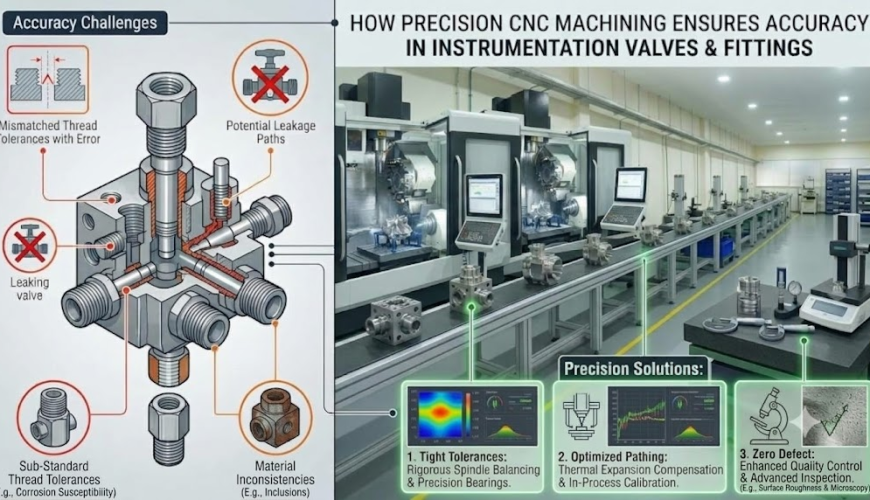
Instrumentation valves and fittings control the flow of liquids and gases in refineries, power plants, chemical facilities, and semiconductor fabs across the world. A small leak or a slightly off dimension in one of these components can force a shutdown, trigger a safety review, or compromise a measurement that an entire process depends on.
Precision CNC machining gives manufacturers the control they need to produce these parts consistently. This article explains where accuracy matters most, how a capable shop maintains it, and what US buyers should expect from a supplier such as Mentco.
Why Accuracy Matters in Instrumentation Valves and Fittings
Instrumentation valves operate under high pressure, wide temperature swings, and constant vibration. Threads, sealing surfaces, and bore diameters must match their specifications closely, or the assembly will leak under load.
Fittings face the same demands, and they often connect to tubing made to strict ASME and ASTM standards. When a fitting is out of tolerance, installers find the problem during pressure testing, which delays commissioning and adds labor cost. Precision CNC machining prevents these issues at the source by holding dimensions the same way on every part.
How Precision CNC Machining Holds Tight Tolerances
Modern CNC turning and milling centers cut metal using programmed toolpaths that repeat with very little variation. Rigid machine construction, temperature controlled spindles, and probing systems let the machine measure itself and correct for tool wear during a run. This is how a shop can hold tolerances of plus or minus 0.0005 inches across a full batch.
Fixturing also plays a large role. A part that shifts even slightly while being cut will not match the drawing, so experienced machinists design fixtures that hold each component the same way every time. Mentco applies this approach to instrumentation components so that the first part and the five hundredth part measure the same.
Sealing Surfaces, Threads, and Bore Quality
The sealing surface of a valve seat usually needs a surface finish measured in single digit Ra values. Achieving that finish requires sharp tooling, correct feed rates, and sometimes a secondary finishing operation. Precision CNC machining makes this result repeatable instead of dependent on the skill of one operator.
Threads such as NPT, BSPP, and SAE straight thread must engage cleanly and seal without excessive torque. Thread form, pitch diameter, and lead all need verification with go and no go gauges or thread micrometers. Bore concentricity matters as well, since an off center bore changes flow behavior and can wear seals unevenly.
Material Choices That Support Accuracy
Instrumentation parts are commonly made from 316 stainless steel, brass, Monel, Hastelloy, and titanium. Each material reacts differently to cutting heat and pressure. Stainless steel work hardens, which means a dull tool or a slow feed can ruin a surface in one pass.
A capable supplier selects tooling and cutting parameters for each alloy instead of using one setup for everything. Material certifications also matter to buyers, so Mentco supplies mill test reports that trace each lot back to its source. This documentation supports audits in oil and gas, pharmaceutical, and semiconductor facilities.
Inspection Steps That Confirm Precision CNC Machining Results
Machining accuracy means little without measurement to prove it. Coordinate measuring machines, optical comparators, and surface roughness testers verify critical features against the drawing. First article inspection confirms the process before full production starts, and in-process checks catch drift while parts are still being cut.
Final inspection reports give buyers a record for each lot. Many customers require this paperwork for quality systems such as ISO 9001 and AS9100. Mentco provides dimensional reports with shipments so quality teams can approve parts without repeating the full inspection.
Project Timeline with a CNC Machining Partner
A clear schedule helps procurement teams plan around lead times. A typical project with Mentco begins with a drawing review and a quote within a few business days. Prototype parts usually follow within two to three weeks, and first article inspection results are shared before production begins.
Production runs ship on the date agreed at the start, with progress updates along the way. Customers receive tracking details and inspection documents when the order leaves the shop.
After Sales Service for Valve and Fitting Programs
Support continues after parts arrive. Mentco keeps program files, fixture records, and inspection data so repeat orders match the original lot. If a customer finds a problem during installation, the team reviews the inspection record and responds with a corrective plan.
Many US customers also ask for design feedback on drawings for new valve and fitting families. Machinists can recommend tolerance adjustments or material changes that lower cost without hurting performance. This ongoing support makes Mentco a dependable partner for long term programs.
Choosing a Precision CNC Machining Supplier in the USA
Buyers should review the supplier’s machines and inspection tools to confirm they can hold the required tolerances. They should also check certifications and experience with similar parts. Requests for sample reports and references give a clearer view of how a supplier works.
Mentco serves US manufacturers in industries that depend on accurate valves and fittings. Customers can send a drawing and receive a clear quote, a timeline, and a quality plan before any commitment.
Frequently Asked Questions
What tolerances can precision CNC machining hold on instrumentation fittings?
- Precision CNC machining can commonly hold tolerances of plus or minus 0.0005 inches, and tighter values are possible depending on the material, part size, and feature.
Which materials does Mentco machine for valves and fittings?
- Mentco machines 316 stainless steel, Aluminium, brass, Monel, Hastelloy, and other exotic alloys used in instrumentation, with mill test reports available for each lot.
How does precision CNC machining improve leak resistance?
- Accurate sealing surfaces, clean threads, and concentric bores let components seat evenly under pressure, which lowers the chance of leaks during operation.
What inspection documents come with an order?
- Customers typically receive dimensional reports, material certificates, and first article inspection results, and other documents can be added when a quality system requires them.
How long does a prototype take?
- Prototype parts usually ship within two to three weeks after drawing approval and raw material availability , though complex designs and special alloys can extend this range.
Does Mentco support repeat orders?
- Yes. Program files and inspection records are stored so later orders match earlier lots in dimensions and finish.
Can Mentco review my drawing before I place an order?
- Yes. The team reviews drawings, flags tolerance or material concerns, and provides a quote with a timeline before any commitment.
