

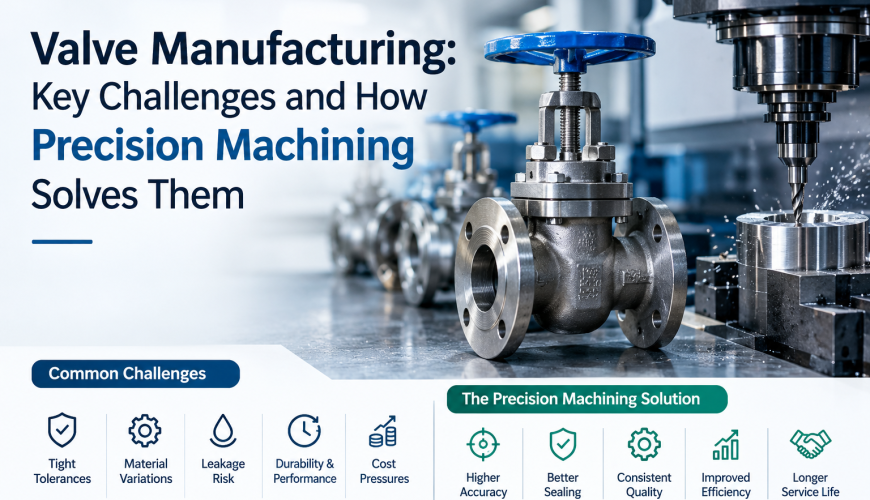
Valve makers work under tight demands. Customers in oil and gas, water treatment, power generation, and pharmaceuticals expect valves that seal properly, last for years, and arrive on schedule. Meeting all three expectations is difficult when parts have complex shapes and strict tolerances.
High precision CNC machining addresses most of these problems at the production stage. This article covers the main challenges in valve manufacturing and shows how Mentco approaches each one.
Challenge 1: Holding Tight Tolerances on Sealing Surfaces
A valve seat, stem, or ball must meet its drawing dimensions closely, or the valve will leak. Small errors in roundness or surface finish allow fluid to pass through even when the valve is closed. Manual machining struggles to repeat these results across a full batch.
High precision CNC machining solves this with programmed toolpaths and in-machine probing. The machine measures key features during the cycle and adjusts for tool wear. Mentco uses this method to keep seat and stem dimensions consistent from the first part to the last.
Challenge 2: Machining Difficult Materials
Valves often use stainless steel, duplex alloys, Inconel, and bronze. These materials resist corrosion, but they also wear out cutting tools quickly and can harden under heat. A wrong feed rate or a worn insert can leave a poor surface that fails under pressure.
A capable shop selects tooling and cutting settings for each alloy. Coolant delivery and tool life tracking also help protect the finish. Mentco matches parameters to the material before production begins, which reduces scrap and protects part quality.
Challenge 3: Complex Internal Geometry
Valve bodies include internal passages, ports, and cavities that must line up accurately. Errors in one bore can affect flow rate and cause uneven wear on seals. Producing these features on several setups often introduces alignment problems.
Multi-axis machines reduce the number of setups by cutting several faces in one clamping. Fewer setups mean fewer chances for error. High precision CNC machining also lets engineers check the final geometry against the model, so problems appear before parts ship.
Challenge 4: Meeting Industry Standards and Documentation
US buyers often require compliance with API, ASME, and ISO standards. They also expect material certificates and inspection records with every shipment. Missing paperwork can hold up delivery and delay a customer’s own project.
Mentco provides mill test reports and dimensional inspection data with each order. Coordinate measuring machines and gauges confirm critical features before parts leave the facility. Quality teams can review the records and approve parts without repeating inspection work.
Project Timeline with Mentco
Clear schedules help procurement teams plan. A typical valve component project starts with a drawing review and a quote within a few business days. Prototype parts usually follow in two to three weeks, and first article results are shared before full production starts.
Production orders ship on the agreed date, and customers receive tracking details with their inspection reports. Mentco shares progress updates during the run so there are no surprises near the delivery date.
After Sales Support for Valve Programs
Support continues once parts arrive. Mentco keeps program files and inspection records on hand, so repeat orders match earlier lots. If a customer finds an issue during assembly, the team reviews the records and works with them on a corrective plan.
Customers also ask for feedback on new designs. Machinists can suggest tolerance or material changes that lower cost without hurting performance. This ongoing relationship makes Mentco a practical partner for long running valve programs.
Why High Precision CNC Machining Matters for Valve Makers
Valve failures cost money through downtime, warranty claims, and damaged customer trust. High precision CNC machining reduces these risks by delivering consistent parts that seal and perform as designed. Buyers who choose a supplier with strong process control spend less time on rework and returns.
Frequently Asked Questions
What tolerances can high precision CNC machining hold on valve parts?
- Tolerances of plus or minus 0.0005 inches are common, and tighter values are possible depending on the material and feature.
Which valve materials does Mentco machine?
- Mentco machines stainless steel, duplex alloys, Inconel, brass, bronze, and other metals used in valve production.
How long does a prototype valve component take?
- Prototype parts usually ship within two to three weeks after drawing approval and raw material availability, though complex parts may need more time.
What documents come with an order?
- Customers receive material certificates and dimensional inspection reports, and other records can be added on request.
Can Mentco handle both small and large production runs?
- Yes. Mentco supports prototype quantities and full production volumes using the same quality checks.
Does Mentco review drawings before quoting?
- Yes. The team reviews each drawing, flags concerns, and provides a quote with a clear timeline.
What happens if a part has a problem after delivery?
- Mentco reviews the inspection records, identifies the cause, and works with the customer on a corrective plan.
