

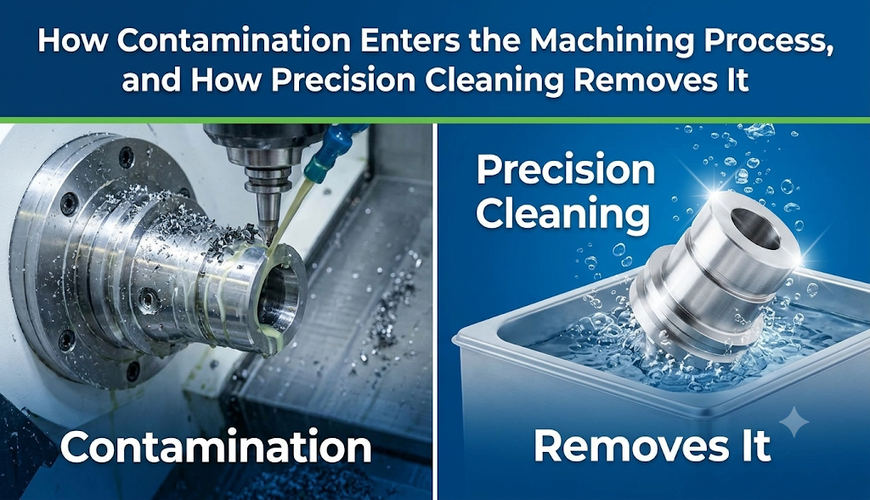
A precision-machined component can meet every dimensional requirement and still fail inspection because of contamination. Metal particles, cutting fluid residues, polishing compounds, and handling oils can remain after machining. In semiconductor manufacturing and other controlled industries, these residues can affect assembly, sealing, equipment reliability, and product quality.
CNC machining creates accurate components, but material removal also produces debris. Precision cleaning removes unwanted substances while protecting the component’s material, dimensions, and surface finish.
Where Contamination Enters the CNC Machining Process
Cutting tools generate chips and fine metal particles that can collect in threaded holes, narrow gaps, and internal channels. If they remain after machining, particles may move during assembly or enter the equipment.
Cutting fluids reduce friction and heat, but residues can remain on surfaces and inside passages. Tool wear can also release fragments that adhere to components or mix with chips.
Dust, dirty fixtures, and contaminated work surfaces can transfer material between operations. Contamination control must cover machining as well as cleaning.
How Handling and Storage Increase Contamination Risks
A component can become contaminated after machining. Bare hands transfer oils and moisture that may interfere with coating, bonding, cleaning, or assembly.
Unclean fixtures can transfer contaminants between jobs. Open containers and unsuitable packaging can introduce dust or particles during storage.
For semiconductor parts, suitable gloves, clean containers, protected work areas, and packaging help keep cleaned components protected until installation.
Why Contamination Control Matters in Precision Machining
In semiconductor equipment, particles can interfere with sensitive processes. Residues in vacuum systems may release gas during operation and affect vacuum conditions.
In fluid-handling equipment, debris can travel through passages and damage valves or pumps. Cutting fluid residues may be incompatible with process media. Particles trapped between sealing surfaces can create leaks, failed tests, and rework.
A defined contamination control process makes cleanliness an acceptance requirement and helps manufacturers maintain consistent results across batches.
What Is Precision Cleaning?
Precision cleaning removes contaminants without damaging material, dimensions, or surface finish. It considers residue type, geometry, material compatibility, and the required cleanliness level.
Manufacturers identify contaminants such as chips, oils, grease, polishing compounds, and dust. They select a cleaning method, solution, temperature, and processing time to suit the part.
Components are rinsed, dried, and inspected before assembly. The goal is a repeatable cleanliness level, not simply a part that looks clean.
For critical parts, buyers should also identify which surfaces or passages require particular attention. A component with blind holes may need a different cleaning sequence from a flat bracket. Sharing drawings, sample parts, and acceptance limits early gives the supplier a clearer basis for choosing the process and planning verification before production.
How Ultrasonic Cleaning Removes Contaminants
Ultrasonic cleaning suits components with small openings, threads, and complex geometries. High-frequency sound waves travel through a liquid and create microscopic bubbles that form and collapse, a process called cavitation.
Bubble collapse near the surface helps dislodge oils, dirt, and particles from internal passages and areas that are difficult to clean manually.
Solution compatibility, frequency, temperature, exposure time, and component design influence results. Delicate coatings and sensitive parts may require another method.
Other Industrial Cleaning Methods
Aqueous cleaning uses water-based solutions and detergents to remove oils and particles when the material is compatible with the chemistry.
Solvents can remove certain oils and greases, but safety, environmental requirements, and residue control matter. Brushing or flushing can remove larger particles from accessible passages.
Rinsing removes cleaning agents and suspended contaminants. Drying prevents moisture trapped in blind holes or channels from causing corrosion. The method should match the part’s specification.
Building an Effective Contamination Control Process
Cleaning cannot compensate for poor manufacturing practices. Manufacturers should maintain fixtures, monitor cutting fluids, remove chips, and separate parts with different cleanliness requirements.
Dedicated containers keep finished parts away from debris. Operators should use gloves and suitable tools. Document the cleaning solution, concentration, processing time, rinsing method, and drying conditions.
Consistent procedures help repeat batches meet the same standard. Records also help trace failures to machining, handling, cleaning, or packaging.
Inspection and Verification after Precision Cleaning
Cleaning needs verification. Visual inspection finds visible particles, stains, corrosion, and residue, but cannot confirm the absence of microscopic contamination.
Verification may include particle extraction or non-volatile residue testing. For semiconductor and vacuum applications, inspection should reflect the contamination risk and intended environment.
Agree on acceptance criteria and documentation before production. Cleaning records, test results, and batch identification support traceability.
Choosing a CNC Machining and Cleaning Partner
Buyers should assess contamination control throughout production. Ask how the supplier manages cutting fluids, maintains fixtures, protects finished parts, and documents inspection. Confirm whether cleaning is in-house or outsourced.
Mentco can be approached for CNC machining projects where accuracy and cleanliness matter. Customers should share drawings, material details, cleanliness specifications, and intended application during the initial review so machining and cleaning requirements can be considered together.
Frequently Asked Questions
What are the most common contaminants in CNC machining?
- Common contaminants include metal chips, fine particles, cutting fluids, lubricants, polishing compounds, dust, and oils transferred during handling.
What is the purpose of precision cleaning?
- It removes unwanted substances from machined components before sensitive applications, assembly, coating, or further processing.
How does ultrasonic cleaning work?
- It uses sound waves to create cavitation bubbles in a liquid solution. Their collapse helps dislodge contaminants from surfaces and difficult-to-reach areas.
Is ultrasonic cleaning suitable for every CNC-machined part?
- No. Material compatibility, geometry, coatings, and cleanliness requirements must be evaluated before selecting the method.
How can manufacturers prevent contamination?
- Regular fixture cleaning, cutting fluid management, controlled handling, chip removal, and suitable storage help reduce contamination risks.
What should buyers discuss with Mentco?
- Customers should confirm available cleaning processes, inspection methods, and documentation options. Providing cleanliness specifications with the initial drawing helps establish manufacturing requirements.
