

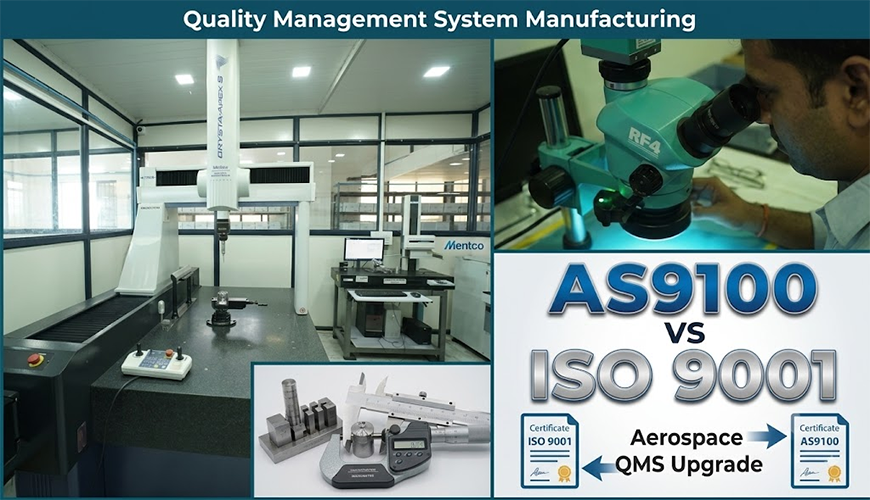
Aerospace and ultra-precision engineering companies rarely begin their evaluation of a new supplier by looking at price and lead times. Before anything else, they want to establish whether the new supplier has the required certification that adheres to quality management system manufacturing.
Two certifications come to mind: ISO 9001 and AS9100. Both certifications require standardized quality systems. They also require third-party involvement and process documentation. But there is a key difference between the two for aerospace and ultra-precision engineering companies.
What Is ISO 9001?
The ISO 9001 standard plays a key role for all industries, as it establishes the minimum requirements for quality control procedures in production. It is the standard established by the International Organization for Standardization for quality tracking purposes.
Any enterprise, be it in the automotive, construction, electrical, or precision manufacturing sector, that produces and delivers quality products or services can use the ISO 9001 certification.
According to ISO 9001, manufacturers must have written procedures, conduct internal audits, keep track of corrections, hold management meetings, and ensure constant improvements. Certification is awarded after a company passes an independent audit and is maintained by regular surveillance audits done annually and complete recertification every three years.
The ISO 9001 is a well-known standard. For most businesses, it provides a basis for suitable and quality equipment in the factories. But for parts production in the aviation industry and high-precision manufacturing, it is only a starting point.
What Is AS9100?
AS9100 is a quality management standard that is made specifically for the aerospace, defense, and space industries. The standard includes all of the specifications outlined in ISO 9001, in addition to other aerospace-based regulations that take into consideration the particular hazards of building safety-critical products.
There is a simple reason for the existence of such standards. In the aerospace and high-accuracy production environment, a single defective product can lead to a system failure with severe consequences. AS9100 is meant to prevent this from happening at every level of the supply chain.
Leading aerospace manufacturers and their tier-one suppliers demand that all their suppliers have AS9100 certification. If the company does not have such a certificate, participation in the aerospace supply chain is impossible, regardless of the machining abilities or costly equipment of the provider.
What AS9100 Adds Beyond ISO 9001?
Formal Risk Management
AS9100 requires manufacturers to formally identify, assess, and document risks throughout the production process. This includes production risks, supplier risks, and design risks. Mitigation plans must be documented and monitored. ISO 9001 addresses risk at a general level. AS9100 requires a structured, auditable process.
Configuration and Revision Control
Parts produced under AS9100 must be traceable to the specific revision of the engineering drawing used to produce them. If a drawing changes, the manufacturer must ensure that only parts produced to the current approved revision are accepted and shipped. This control is essential in aerospace programs where design updates occur regularly and older revision parts cannot be mixed with current ones.
First Article Inspection
AS9100 mandates formal first article inspection for new parts and for existing parts following significant process changes. FAI confirms that the entire production process, including materials, tooling, fixturing, machining parameters, and inspection methods, is capable of consistently producing conforming parts. This is a non-negotiable requirement for aerospace and high-precision manufacturing customers.
Key Characteristics
AS9100 requires manufacturers to identify features that are critical to part function, safety, or fit. These key characteristics receive additional process controls, inspection frequency, and documentation beyond standard requirements. In aerospace components, key characteristics often include critical diameters, surface finishes, and thread specifications that directly affect structural integrity or system performance.
Counterfeit Parts Prevention
The aerospace supply chain is a documented target for counterfeit materials, fasteners, and electronic components. AS9100 includes specific requirements for verifying the authenticity of materials and purchased components throughout the supply chain. Suppliers must have documented processes for identifying and controlling suspect counterfeit material.
Supplier Flow-Down and Control
AS9100 places strict requirements on how manufacturers manage their own sub-tier suppliers. Quality requirements must flow down to every supplier that contributes materials or services to an aerospace part. This traceability through the supply chain is what allows aerospace programs to maintain accountability from raw material to finished component.
What This Means for Aerospace and High-Precision Manufacturing Buyers
For procurement teams sourcing components for aerospace programs, defense systems, or high-precision manufacturing applications, AS9100 certification is a threshold requirement. A supplier without it cannot enter your approved vendor list, regardless of its equipment or track record in other industries.
For suppliers already certified to ISO 9001 and considering AS9100, the additional investment in the upgraded quality management system manufacturing framework pays returns beyond aerospace market access. The process disciplines required by AS9100, particularly risk management, configuration control, and first article inspection, improve manufacturing consistency across all production work, not just aerospace jobs.
For high-precision manufacturing customers in oil and gas, semiconductor, robotics, and instrumentation, working with an AS9100 certified supplier means working with a shop that operates to a higher standard than the market requires of it. The inspection rigor, documentation practices, and process controls built into AS9100 translate directly into more consistent parts and more reliable supply chain performance.
Certification in Practice: What to Look For Beyond the Certificate
A certificate on a supplier’s website confirms that an audit was completed and passed. It does not tell you how that supplier performs day to day on the production floor.
When evaluating a quality management system manufacturing operation for aerospace or high-precision work, go beyond the certificate. Ask for recent corrective action records. Ask how the supplier handles non-conforming material at incoming inspection, in-process, and final inspection. Ask to see a sample first article inspection report. Ask what their internal rejection rate looks like across a recent production period.
These questions reveal how a quality system performs under real production conditions. A supplier with mature AS9100 processes will answer these questions directly and provide documentation without hesitation.
Mentco: AS9100 Certified Precision Machining
Mentco holds AS 9100:2016, ISO 9001:2015, EN 9100:2018, and JISQ:2016 certifications, supporting customers across aerospace, oil and gas, robotics, semiconductor, instrumentation, and industrial automation industries throughout the United States.
Mentco’s quality management system manufacturing framework includes in-house CMM inspection systems, documented first article inspection processes, formal corrective action procedures, and strict material traceability from raw stock through finished component.
For aerospace customers, Mentco’s AS9100 certification means the quality infrastructure required by your program compliance requirements is already in place. For high-precision manufacturing customers in other sectors, it means you are working with a supplier whose quality management system manufacturing processes are held to one of the most demanding standards in global manufacturing.
Every Mentco shipment includes complete inspection documentation, and the team provides direct, responsive support for any quality questions that arise after delivery.
Concluding Insights
ISO 9001 provides a strong basis for the implementation of quality management system manufacturing for various industries. AS9100 builds on that foundation and provides a stricter system in aerospace applications, where component failure is unacceptable.
Mentco has received AS9100 certification, demonstrating its commitment to quality management systems in the aerospace and precision manufacturing sectors. For US manufacturers seeking a certified precision machining partner equipped to deliver and commit to its quality standards, Mentco stands as the reliable option.

[…] buyers a record for each lot. Many customers require this paperwork for quality systems such as ISO 9001 and AS9100. Mentco provides dimensional reports with shipments so quality teams can approve parts without […]