

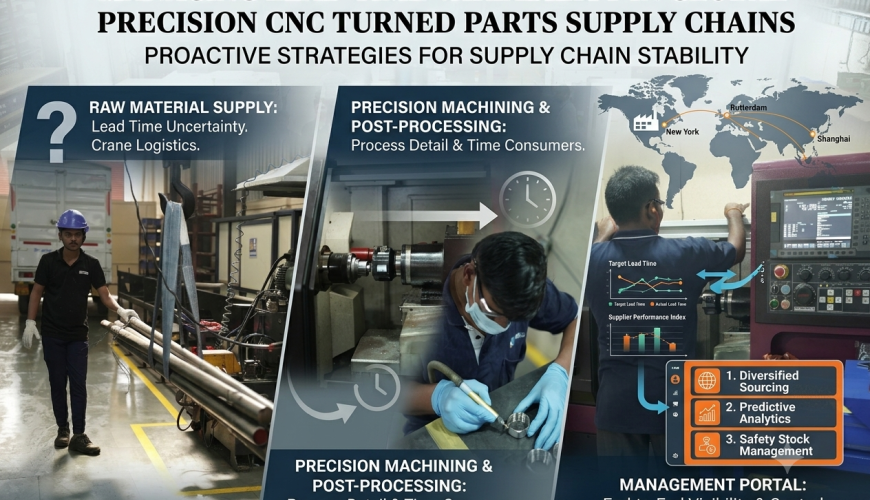
Timing of delivery determines production schedules; if a CNC turned parts supplier meets the deadline for delivery, it enables smooth operations at all secondary stages. On the contrary, in case of any deviations from the lead time, it results in a negative impact on assembly, inventory, and the promise of goods to a customer.
Lead time variability causes a great deal of trouble for US manufacturers because precision components are obtained from all parts of the globe. If the source of variability is analyzed and appropriate actions are taken to get its effects under control, it will help procurement and operations professionals to solve the problems that arise in the process of supply chain management.
What Causes Lead Time Variability in CNC Turned Parts Supply Chains
· Material Availability
Certain grades of aluminum, stainless steel, titanium, and various metals are usually needed for CNC turning operations. Because mill delivery dates can be altered when demand for raw materials increases, other uses of materials will not keep pace and lead a supplier to delay the order.
· Availability of Machine and Its Scheduling
Being always on time during the production process is a rule for precision machining. In case there are any sudden changes in the order, the supplier will surely take more time to bring that order to the required specification.
· Quality Inspection Process
Precision machining helps in receiving high-quality products with a certain set of characteristics. However, it takes time for the supplier to check compliance of products with these specifications.
· Shipping and Customs Clearance
Shipments from abroad take time to reach to their destination. It is important to take into account shipping, delivery, customs registration, clearance, port congestion and other possible related issues that may cause delay.
· Delays for Tooling Process
Operation and direct use of tools take time. There are a lot of obstacles that can happen during the tooling process.
Strategies for Reducing Lead Time Variability
· Finding Possible Suppliers
Having only one supplier for CNC turned parts means your single point of failure. This is due to the fact that when the supplier has any problems regarding their ability, production machinery or quality of provided parts stops. If more than one supplier is qualified for the critical parts, you have alternative options if something goes wrong with one of them.
· Place Blanket Orders and Schedule Them
Blanket orders give an opportunity for a supplier to program their production in advance instead of reacting to each separate order from buyers. This leads to higher comfort during the supplier’s production planning process and to the company having quicker and more stable delivery schedules.
· Disclose Sales Forecasts on Time
The suppliers make production and material planning based on what they predict to produce. Thus, if you deliver the sales forecasts for 90 days or even for 6 months ahead, the supplier will be able to plan production and purchase all necessary materials beforehand.
· Get Written Lead Time Commitments
You should get written lead time quotes from the supplier because your verbal lead time quote cannot be taken as production commitments. Let your supplier acknowledge the lead time in the purchase order confirmation and have a procedure in place for communicating the delays, if any, so that the supplier can notify you before the delivery date.
· Keep checking the Capacity of Suppliers
Supplier capacity keeps changing. The capacity of a supplier operating six months ago may not be the same now. It is better to talk to your significant suppliers to know their capacity before placing orders.
The Role of Communication in Lead Time Management
Communication is one of the least utilized practices in supply chain lead time management. The top supplier relationships are built on open and constant communication both ways.
The supplier needs to inform you immediately if there is a possibility for a delivery date to be missed before it actually happens. Similarly, you should also inform your supplier of changes in your production scheduling before they affect your ordering process.
When choosing a supplier, observe their mode of communication carefully during quotation and sampling. Suppliers who take a long time in giving feedback at the early stages of communication remain the same even when production begins.
After-Delivery Support and Accountability
The process of lead time management carries on even as the components arrive. What follows the arrival of the package is equally as important as the production process.
A good CNC parts provider includes inspection documents every time a shipment is sent. This gives the company an edge since it can ascertain when a product was manufactured in case quality issues arise after delivery.
Make it a point to ask the shipping service about the manner in which any post-delivery quality disputes are handled. If the company in question has appropriate mechanisms and procedures for handling such cases, one can be assured that the provider will take the matter seriously.
How Mentco Manufacturing Supports Lead Time Reliability
Mentco inc is a CNC turned parts supplier from the USA that has AS9100 and ISO certified processes. At present, the company supplies its high-quality products to the aerospace, oil and gas, robotics, instrumentation, semiconductors, and industrial automation industries.
Mentco follows a rigorous production process that includes the use of confirmed lead times, inspection during production, and a CMM inspection process. Customers are kept updated about their orders at all times by Mentco.
Mentco is the best CNC turned parts supplier for the American market.
Concluding Insights
The variability in lead times in the global precision CNC turned parts supply chain is manageable only if sufficient planning, meticulous supplier relations, and effective communication processes are put in place.
Manufacturers who succeed in overcoming supply chain disruptions have qualified several suppliers, entered into blanket agreements, forecasted market conditions, and selected communication partners that are reliable in delivering the goods.
It takes time to develop such supply chains, but they prove their worth every time a disruption occurs in the market.
