

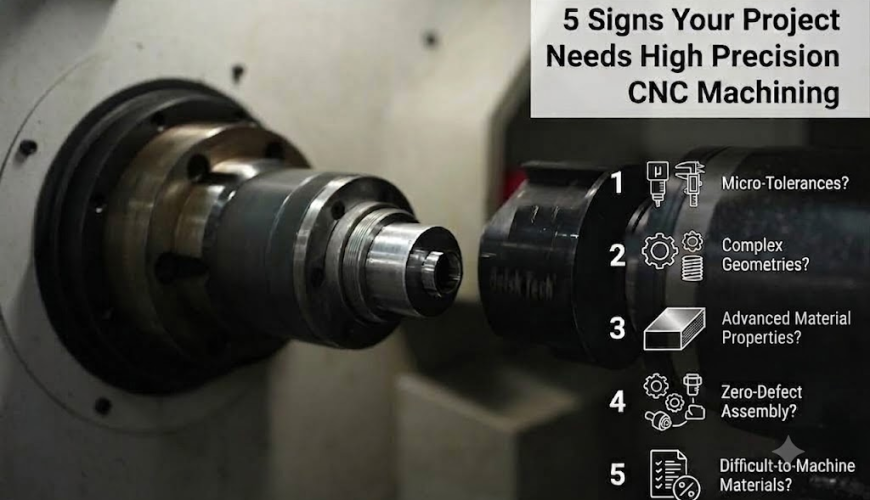
Not every project needs high precision CNC machining. Simple brackets, low-stress fixtures, and parts with loose tolerances can often be produced with standard machining or even other manufacturing methods at a lower cost. But when a project involves tight tolerances, critical function, or regulatory requirements, cutting corners on precision creates risk that shows up later in the form of failed assemblies or product recalls.
This blog post covers five clear signs that a project calls for precision CNC machining, along with what buyers across the USA should look for when choosing a partner for this type of work.
Sign 1: Your Tolerances Are Measured in Thousandths of an Inch
If a part drawing specifies tolerances of plus or minus 0.0002 inches or tighter, standard machining processes will not consistently deliver acceptable results. High precision CNC machining uses calibrated equipment, controlled environments, and repeated in-process inspection to hold these tight tolerances across an entire production run.
Parts with tolerances this tight are common in aerospace fittings, medical instruments, semi conductor precision parts, and precision fluid control components. A CNC machining manufacturer without the right equipment and inspection process will produce parts that pass on some units and fail on others, which is a costly problem to discover after assembly.
Sign 2: The Part Has a Complex Geometry or Multiple Critical Features
Parts with multiple critical dimensions, internal features, or complex angles are difficult to produce accurately without advanced multi-axis CNC machine. When several features on a single part must align perfectly with each other, even small errors compound quickly across the piece.
Precision CNC machining handles this complexity by using programmed tool paths that maintain consistency across every feature on the part. Buyers working with CNC machining companies on complex geometries should ask to see examples of similar parts the shop has produced, along with the inspection reports that confirm those parts met specification.
Sign 3: Your Industry Requires Certification and Documentation
Industries such as aerospace, medical devices, defense, and automotive in the USA often have stringent quality and compliance requirements, including material certifications, dimensional inspection reports, full traceability, and PPAP(Production Part Approval Process) documentation, where applicable, to ensure that manufactured parts meet specified quality and engineering standards. Projects in these industries almost always require high precision CNC machining paired with a documented quality system.
A shop that cannot provide certificates of conformance or material traceability is not equipped to support regulated industries, regardless of how good their machines look on paper. When evaluating a CNC machining manufacturer for regulated work, confirm their documentation process before placing an order, not after receiving a shipment that cannot be accepted by your quality team.
Sign 4: Previous Parts Have Failed in the Field
If a component has failed during use, whether through wear, fatigue, or dimensional drift, that failure often points to a machining process that was not tight enough for the application. Moving to precision CNC machining with proper tolerance control and surface finish specification often resolves recurring field failures.
Before switching suppliers, it helps to have the failed part analyzed to confirm the root cause. Mentco offers this kind of failure analysis as part of the quoting process for customers coming from a previous supplier, so the new production run addresses the actual problem instead of repeating it.
Sign 5: Your Assembly Depends on Consistent Fit across Every Unit
Some projects can tolerate small variation between parts. Others depend on a consistent fit every single time, particularly in assemblies with moving parts, sealed components, or press fits. When consistency across hundreds or thousands of units matters more than any other factor, high precision CNC machining is the appropriate choice.
This level of consistency requires calibrated machines, verified tooling, and in-process inspection at set intervals throughout a production run. CNC machining companies that skip these checks may produce parts that measure correctly on average but vary enough between individual units to cause assembly problems on the production floor.
What to Look for in a Precision CNC Machining Partner
Once a project shows one or more of these signs, choosing the right partner matters as much as recognizing the need for precision work. Look for a CNC machining manufacturer with documented quality processes, clear communication about timelines, and a track record with similar parts in your industry.
Mentco works with customers across the USA, UK & Europe on projects that require precision CNC machining, turning, milling, and custom machine manufacturing. Every project starts with a review of the part requirements and a realistic timeline, so customers know what to expect from quote to delivery.
Timelines and Support Customers Can Rely On
A precision project is only successful if it arrives on schedule and performs as expected once installed. Mentco provides customers with a clear timeline at the start of every project, covering prototyping, first article inspection, and full production, and communicates promptly if any part of that schedule needs to change.
After a part ships, Mentco remains available to support customers with documentation requests, technical questions, or any issue that comes up during installation. This ongoing relationship is part of why manufacturers continue working with Mentco rather than searching for new CNC machining companies for every new project.
Frequently Asked Questions
How tight do tolerances need to be before I need precision CNC machining?
- Generally, tolerances tighter than plus or minus 0.005 inches call for precision CNC machining rather than standard processes, though the right answer depends on the part’s function and industry.
Is precision CNC machining more expensive than standard machining?
- It typically costs more per part due to tighter controls and additional inspection, but it reduces the cost of field failures, rework, and scrap on projects where tolerance matters.
What materials work best with high precision CNC machining?
- Aluminum, stainless steel, titanium, and various engineering plastics are all commonly used, with material choice depending on the part’s mechanical and environmental requirements.
How do I choose between different CNC machining companies for a regulated industry project?
- Compare their documentation process, certifications, in-process inspection practices, and experience with similar parts in your specific industry before making a decision.
Can Mentco help if my current parts are failing in the field?
- Yes. Mentco can review failed parts to identify the root cause and recommend process changes for a new production run that addresses the issue directly.
What information should I send a CNC machining manufacturer for an accurate quote?
- A complete drawing with tolerances, material specification, quantity, and any certification requirements will help a CNC machining manufacturer provide an accurate quote and timeline.
Does Mentco support both small prototype runs and large production volumes?
- Yes. Mentco works with customers on prototype quantities as well as full production runs, applying the same precision CNC machining standards at every volume.
