

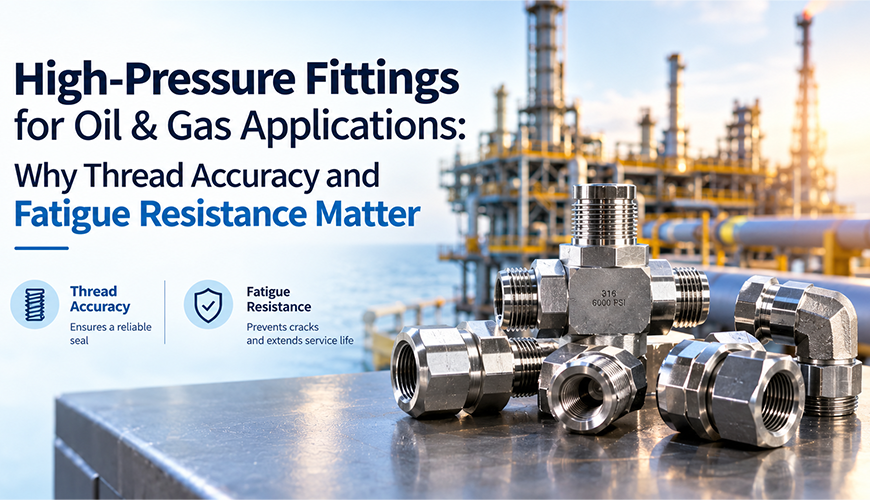
Oil and gas systems operate under high pressure, temperature swings, and constant vibration. A single fitting that leaks or cracks can shut down a line, damage equipment, or put workers at risk. Thread accuracy and fatigue resistance are two of the main factors that decide whether a fitting lasts or fails.
For buyers and engineers, understanding these two factors makes it easier to specify the right parts and evaluate a machining supplier. This blog covers how threads and fatigue behavior affect performance, and what to look for in manufacturing.
Why High-Pressure Fittings Are Critical in Oil and Gas
Fittings connect pipes, valves, gauges, and instruments across wellheads, pipelines, refineries, and processing units. They carry crude oil, natural gas, hydraulic fluid, and chemicals at pressures that can reach several thousand psi. Every connection is a possible leak point, so each fitting must hold its seal over years of service.
The environment adds further demands. Fittings face corrosive media, sour gas, saltwater exposure, and temperature changes between hot process fluids and cold outdoor conditions. A fitting that performs well on a test bench can still fail in the field if the design, material, or machining does not match these conditions.
Why Thread Accuracy Matters
Threads do two jobs at once. They hold the connection together mechanically, and in many designs they help form the seal. When thread pitch, form, or depth deviates from the specification, the load spreads unevenly across the engaged turns. Some turns carry too much stress while others carry almost none.
Poor thread quality also causes practical problems during installation. Cross-threading, galling, and over-tightening become more likely, and leaks may appear only after pressure cycles begin. Accurate threads, whether NPT, BSPP, or UN/UNF, give consistent engagement and predictable torque values, which makes assembly reliable in the field.
How Fatigue Affects High-Pressure Fittings
Fatigue failure happens when a part is loaded and unloaded repeatedly, even at stress levels well below its yield strength. In oil and gas systems, pressure pulsations, pump vibration, and thermal cycling create these repeating loads. Small cracks start at stress concentration points and grow slowly until the fitting fails.
Threads are common starting points for fatigue cracks because the root of each thread concentrates stress. Sharp root radii, tool marks, and surface defects make the problem worse. Fittings designed for cyclic service use controlled thread root profiles and smooth surface finishes to reduce these stress points.
The Role of Material Selection and Heat Treatment
Material choice sets the baseline for strength, corrosion resistance, and fatigue life. Stainless steel grades such as 316 are widely used for general corrosion resistance. Duplex stainless steels and nickel alloys such as Inconel 625 suit sour gas, subsea, and high-chloride environments. Carbon and alloy steels are common where strength and cost are the priority.
Heat treatment and material traceability matter as much as the grade itself. Correct treatment gives consistent hardness and strength, while mill certificates confirm that the bar stock matches the specification. Buyers in oil and gas often require full material test reports for each batch.
How CNC Machining Supports Thread Accuracy and Fatigue Resistance
CNC machines hold tight tolerances on thread geometry from the first part to the last. Single-point threading and thread milling allow precise control of pitch diameter, flank angle, and root radius. This repeatability matters for production runs, where small variations between parts can lead to inconsistent sealing.
Machining practice also affects fatigue life directly. Sharp tools, correct cutting speeds, and proper coolant use produce a clean surface with minimal tool marks. Some manufacturers add rolling or polishing operations on threads and transitions to improve surface quality and reduce crack initiation points.
Inspection and Quality Control
Thread gauges such as go/no-go ring and plug gauges confirm that threads meet specification. Coordinate measuring machines (CMMs) and optical comparators check critical dimensions, including bores, sealing faces, and concentricity. Surface roughness testers verify that finishes fall within the required range.
For high-pressure service, additional checks are common. Pressure testing, dye penetrant inspection, and positive material identification (PMI) help detect leaks, surface cracks, and wrong-grade material before parts ship. Documented inspection records give buyers a clear quality trail.
Choosing the Right Machining Partner
A good partner for oil and gas fittings has experience with the relevant alloys, standards, and tolerances. Ask about their threading capabilities, inspection equipment, and how they handle material traceability. Sample parts and past project references show how consistently they deliver.
Communication also matters. Clear drawings, agreed tolerances, and defined inspection requirements at the start of a project prevent costly rework later. A supplier who asks detailed questions about operating pressure, media, and cycling conditions usually understands the application well.
Conclusion
Thread accuracy and fatigue resistance directly affect the safety and service life of high-pressure fittings in oil and gas systems. Precise threads give a reliable seal and even load distribution, while fatigue-aware design and machining reduce the risk of cracks over time.
Mentco produces precision CNC machined components with tight tolerances, documented inspection, and material traceability. To discuss your fitting requirements, contact the Mentco team with your drawings and operating conditions.
FAQs
1. Why is thread accuracy important in high-pressure fittings for oil and gas systems?
- Threads hold the connection together and often help form the seal. Accurate threads spread the load evenly and reduce the risk of leaks, galling, and cross-threading.
2. What causes fatigue failure in high-pressure fittings?
- Repeated loading from pressure pulsations, vibration, and thermal cycling causes small cracks to form, usually at thread roots. These cracks grow with each cycle until the fitting leaks or breaks.
3. Which materials are best for high-pressure oil and gas fittings?
- Stainless steel 316 suits general corrosion resistance, while duplex stainless steels and Inconel 625 suit sour gas, subsea, and high-chloride conditions. Carbon and alloy steels work where strength and cost matter most.
4. How does CNC machining improve the quality of high-pressure fittings?
- CNC machining holds tight thread tolerances across every part in a production run. Sharp tools and correct cutting parameters also leave smooth surfaces that reduce crack starting points.
5. What inspection tests should high-pressure fittings pass before use?
- Common checks include go/no-go thread gauging, CMM measurement, pressure testing, dye penetrant inspection, and positive material identification (PMI). Together they confirm correct dimensions, sealing performance, and material grade.
